

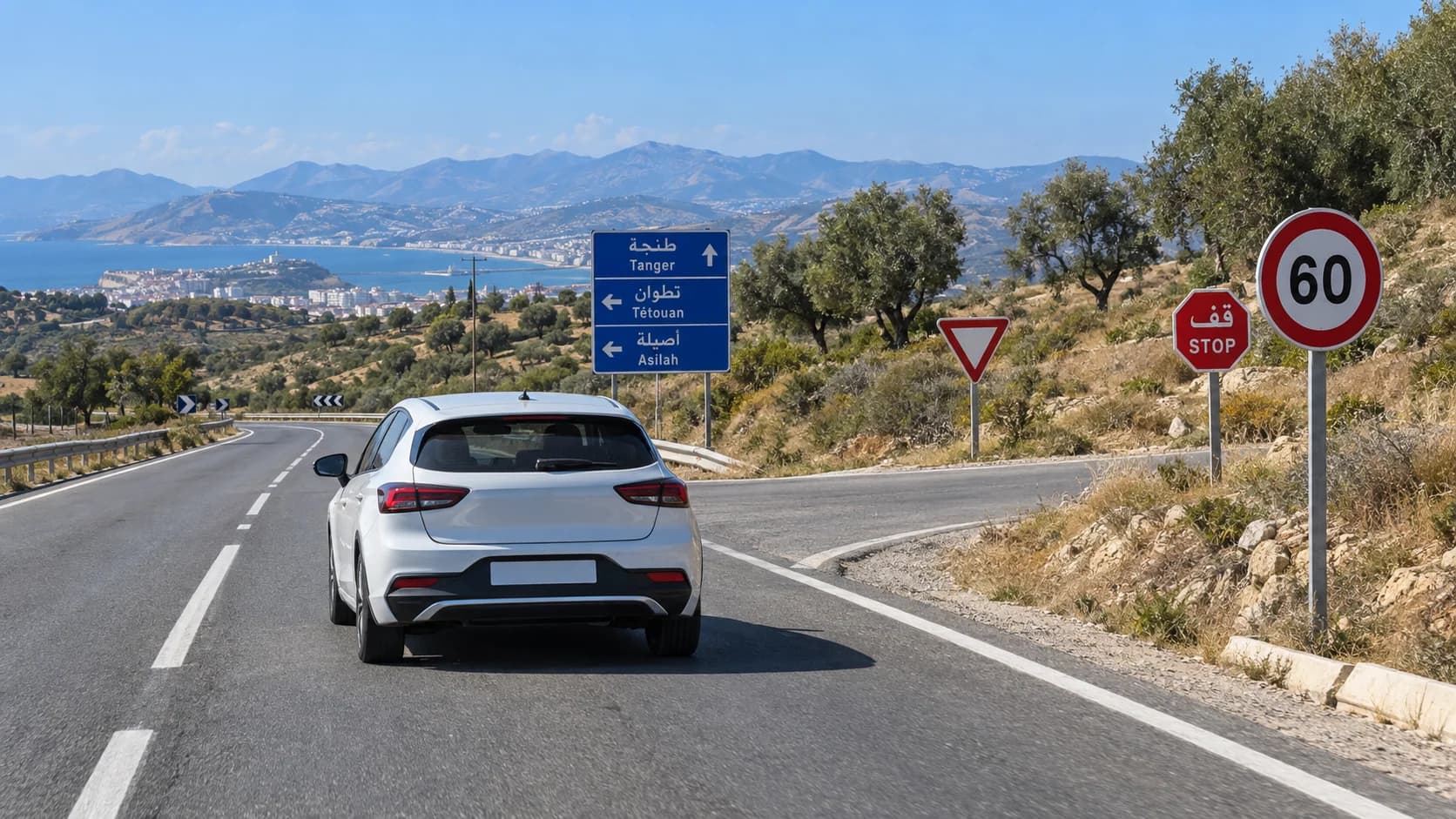
Driving independently is one of the easiest ways to explore Morocco beyond the main city centers, but unfamiliar signs can make the first few kilometres feel more complicated than they need to be. Fortunately, Morocco road signs for tourists use standardized shapes, colours and symbols that will look familiar to many drivers from Europe and other countries using international-style road signage.
Morocco's road-sign system is formally regulated through national road-sign legislation and the country's Instruction Générale sur la Signalisation Routière. The system includes warning signs, priority signs, prohibitions, mandatory directions, parking controls, motorway information and road markings. Morocco also participates in the international framework established by the Vienna Convention on Road Signs and Signals.
For visitors collecting a rental car in Tangier and heading toward places such as Tetouan, Chefchaouen, Rabat or Morocco's Atlantic coast, you do not need to memorize every sign before leaving. You should, however, recognize the signs that directly affect speed, right of way, access, parking and motorway driving.
Table of Contents
- Why road-sign familiarity matters
- Speed-limit signs
- Priority and give-way signs
- No-entry and restriction signs
- Parking and stopping signs
- Motorway and direction signs
- Road markings tourists should notice
- Quick road-sign reference before driving
- FAQs about Morocco road signs for tourists
What Road Signs Should Tourists Know in Morocco?
The most important Moroccan road signs for rental-car drivers are:
| Sign type | What to recognize | What the driver should do |
|---|---|---|
| Speed limit | Number inside a red-bordered circular sign | Stay at or below the posted limit |
| Stop | Red octagonal sign | Come to a complete stop |
| Give way | Inverted triangular sign with red border | Slow and yield as required |
| Priority road | Diamond-shaped priority sign | Recognize that the road has priority status |
| No entry | Red circular prohibition sign | Do not enter from that direction |
| No parking | Circular parking-prohibition sign | Do not leave the vehicle parked where prohibited |
| No stopping | More restrictive stopping prohibition | Do not stop or park where it applies |
| Mandatory direction | Blue circular sign with white arrow | Follow the direction indicated |
| Motorway | Motorway symbol | Motorway rules and signage begin |
| Motorway exit | Directional sign toward the exit | Move into the correct lane early and safely |
| Roadworks | Temporary warnings, signs or markings | Reduce speed and follow temporary traffic guidance |
| Pedestrian crossing | Pedestrian-crossing symbol and/or markings | Watch carefully for people crossing |
Morocco's official sign catalogue contains separate categories for danger, priority, prohibition, mandatory instructions, parking, motorways and other road information.
The easiest strategy is not to memorize hundreds of individual signs. Learn the major shapes, colours and driver actions, then pay close attention to posted instructions during your journey.
Why Road-Sign Familiarity Matters
Visitors often focus on navigation before renting a car: which road reaches Chefchaouen, where the motorway begins or which exit leads toward their hotel. Road signs perform a different job. They tell you what you are allowed or required to do at that exact part of the road.
A navigation application may tell you to continue straight, for example, while temporary roadworks instruct traffic to move into another lane. The physical road signs and traffic controls in front of you must take priority over what your navigation application expected.
The Vienna Convention framework also establishes the broader principle that road users must comply with road signs, traffic signals and road markings.
Learn the shape before the language
For a tourist, sign shape can often communicate the basic message before you have read any words:
-
Triangular warning signs alert you to a hazard ahead.
-
Red-bordered circular signs commonly communicate restrictions or prohibitions.
-
Blue circular signs commonly communicate mandatory actions.
-
Directional and information signs guide you toward destinations, road facilities and routes.
-
STOP has the familiar octagonal format.
-
Give-way signs use the familiar inverted triangle.
This is why driving in Morocco can feel more familiar after the first few kilometres than the Arabic script might initially suggest.
The Moroccan National Tourist Office confirms that vehicles drive on the right in Morocco and that road signs are commonly displayed in French and Arabic.
Speed-Limit Signs
One of the first Morocco driving signs rental-car users should recognize is the speed-limit sign.
What does a Moroccan speed-limit sign look like?
A maximum-speed sign displays a number inside a circular sign with a red border. The number is expressed in kilometres per hour.
For example, if you see 80 inside the speed-limit circle, treat 80 km/h as the maximum posted speed for that section unless subsequent signage changes or ends the restriction.
Morocco's official road-sign nomenclature includes both maximum-speed signs and signs showing the end of a previously indicated speed restriction.
Do not assume the same speed throughout a journey
A road can change character quickly.
You may travel from:
motorway → exit ramp → national road → village → urban boulevard.
The applicable posted limit can therefore change several times during one journey. Watch especially carefully when:
-
entering or leaving a town;
-
approaching junctions;
-
approaching roadworks;
-
descending steep roads;
-
driving near schools or busy pedestrian areas;
-
joining or leaving a motorway.
The safest tourist habit is simple: follow the current posted sign rather than relying on what the previous road allowed.
Priority and Give-Way Signs
Priority signs deserve extra attention because they control what happens at intersections, roundabouts and road merges.
Morocco's sign system specifically includes STOP, give-way, priority-intersection, roundabout, priority-road and end-of-priority-road signs.
STOP sign
A STOP sign uses the unmistakable red octagonal shape.
Driver action: come to a complete stop, check the intersection carefully and continue only when it is safe and permitted.
Because its shape is internationally recognizable, tourists do not need to rely entirely on the written language.
Give-way sign
The give-way or yield sign is an inverted triangle with a red border.
Driver action: reduce speed, assess approaching traffic and give priority where required.
Do not treat give way as automatically equivalent to STOP. Whether you need to stop completely depends on traffic conditions and the junction.
Priority-road sign
Morocco also uses a diamond-shaped sign indicating that the road has priority status, together with a corresponding sign showing the end of that priority status.
These signs are particularly useful on roads where several smaller roads intersect.
Roundabouts
When approaching a roundabout, avoid using a single rule such as "traffic inside always has priority" without looking at the junction itself.
Instead:
-
reduce speed;
-
locate the give-way or priority signs;
-
check the road markings;
-
watch traffic already circulating;
-
enter only when permitted and safe.
Different layouts and signs can affect how an individual junction operates, so the signage directly in front of you is the information that matters most.
No-Entry and Restriction Signs
Prohibition signs can prevent you from accidentally entering the wrong street, turning where a movement is prohibited or taking a vehicle onto an unsuitable road.
No entry
Morocco's road-sign catalogue includes a specific no-entry sign.
Driver action: do not enter the road from the direction where the sign is facing.
This is particularly relevant in dense city districts where one-way systems may redirect traffic.
No left turn, no right turn and no U-turn
Separate signs prohibit:
-
turning left;
-
turning right;
-
making a U-turn.
Do not rely solely on navigation when approaching a complicated urban junction. A navigation route may not always reflect a recent traffic-layout change or temporary restriction.
Vehicle restrictions
You may also encounter signs restricting specific types of vehicles or setting limits relating to matters such as:
-
vehicle height;
-
vehicle width;
-
total weight;
-
overtaking;
-
access for certain vehicle categories.
Most ordinary rental-car tourists will rarely need to interpret specialist heavy-vehicle restrictions, but the general lesson remains useful: a red-bordered circular sign deserves your attention before continuing.
Parking and Stopping Signs
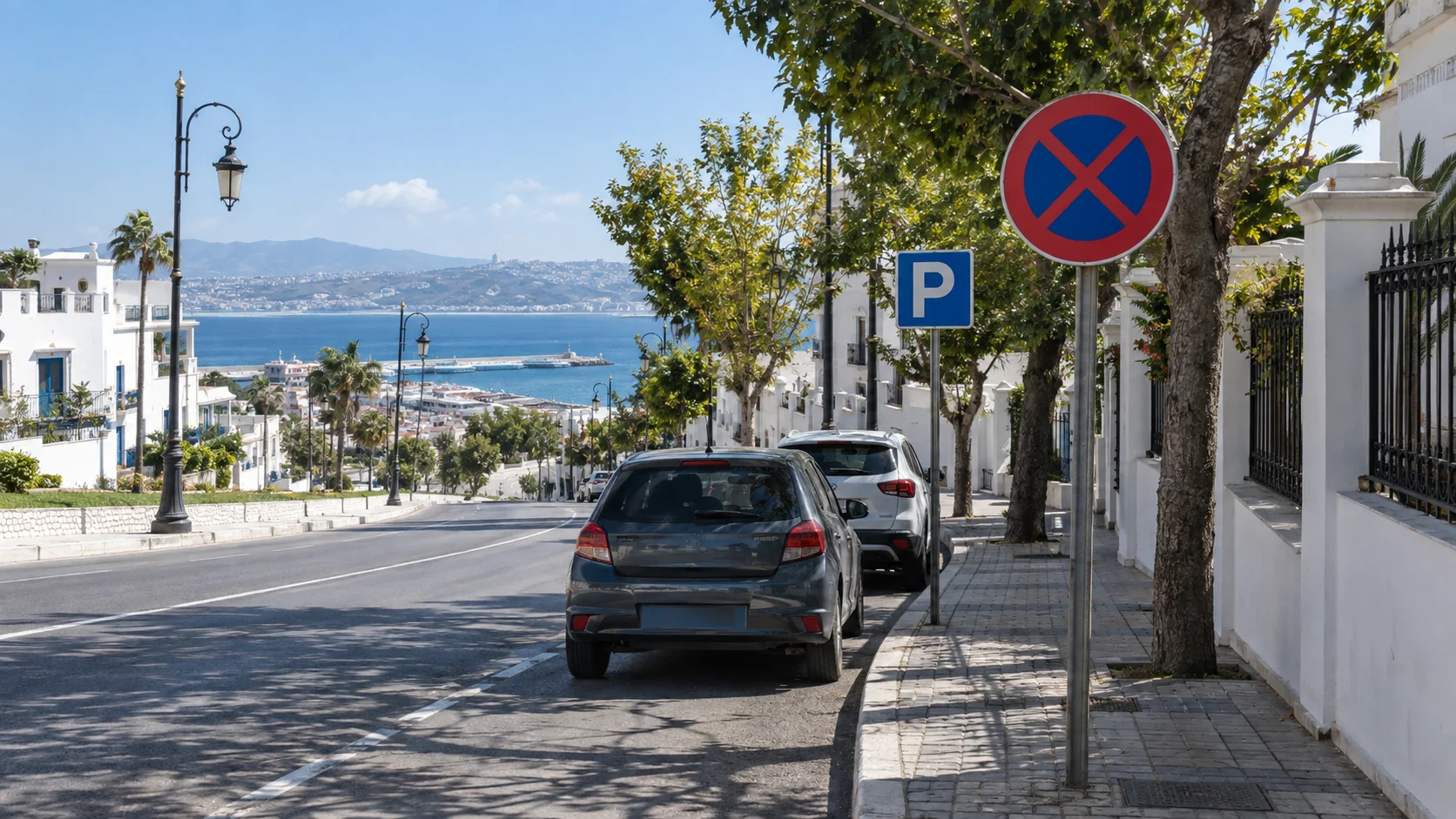
Parking is one of the areas where tourists should be particularly careful in Moroccan cities.
Do not assume that an open curb means parking is permitted.
Morocco's road-sign system distinguishes between no parking, no stopping, parking zones, paid parking and other parking-related instructions.
No parking
A no-parking sign means you should not leave the rental car parked within the area to which the restriction applies.
Watch for additional plates or information explaining where or when the restriction operates.
No stopping
A no-stopping restriction is stronger.
Rather than interpreting every curb based on what other vehicles are doing, look for the official sign and any supplementary information.
Parking signs
A blue parking sign with the familiar P identifies an authorized parking area. Morocco's current sign catalogue also contains signs for paid parking and other designated parking arrangements.
In Tangier, Marrakech, Casablanca, Rabat, Fes and other busy cities, it is usually easier to identify a clearly designated parking area than to improvise a space near a crowded junction.
Motorway and Direction Signs
Motorway signage becomes particularly important on longer Morocco road trips.
For a traveler starting with car rental in Tangier, the motorway network can be useful when continuing south toward cities such as Rabat or Casablanca.
Motorway signs
Morocco's road-sign catalogue includes specific symbols for:
-
motorway entry;
-
end of motorway;
-
toll facilities;
-
electronic toll payment;
-
conventional toll payment;
-
motorway-related information.
Once you enter a motorway, continue to monitor speed limits, lane-control signs and exit directions rather than assuming conditions remain identical for the entire journey.
Morocco's motorway operator, Autoroutes du Maroc, also uses permanent and temporary signage, variable-message boards and horizontal road markings to manage traffic and warn drivers about changing conditions.
Direction signs and languages
One common question is whether tourists need to read Arabic to navigate in Morocco.
Usually, no.
The Moroccan National Tourist Office states that road signs commonly use Arabic and French. Depending on the route and sign, travelers may also encounter Tamazight and Latin-script place names.
For navigation, concentrate on destination names rather than trying to translate every word.
Before leaving Tangier, for example, know the Latin spelling of your next major destination:
-
Tetouan
-
Chefchaouen
-
Rabat
-
Casablanca
-
Asilah
Then compare that destination with the overhead or roadside signs as you approach major junctions.
Useful French words on road signs
A few words can make motorway and urban navigation easier:
| French | Meaning |
|---|---|
| Sortie | Exit |
| Péage | Toll |
| Centre-ville | City centre |
| Déviation | Diversion/detour |
| Travaux | Roadworks |
| Stationnement | Parking |
| Aéroport | Airport |
You do not need to speak French fluently. Recognizing a handful of navigation-related words is normally enough to reduce uncertainty.
Road Markings Tourists Should Notice
Road signs are only part of Morocco's traffic-control system. Road markings are also instructions, particularly around intersections, lane changes and roadworks.
Lane lines
Pay attention to whether the line beside you is broken or continuous before overtaking, turning or changing lanes.
Rather than making assumptions based on how another driver behaves, follow the markings applicable to your own lane.
Stop and give-way markings
At junctions you may see horizontal markings working together with STOP or give-way signs.
Slow early enough to identify both the sign and the line on the road.
Direction arrows
Lane arrows can indicate that a lane is intended for:
-
straight ahead;
-
left turn;
-
right turn;
-
another specified movement.
Getting into the correct lane early is particularly useful on larger urban boulevards.
Pedestrian crossings
Marked pedestrian crossings deserve extra attention in cities and towns.
Reduce speed and scan both sides of the road rather than focusing only on the vehicle ahead.
Temporary yellow markings
Roadworks can temporarily alter the normal lane configuration.
Autoroutes du Maroc specifically explains that temporary yellow horizontal markings may be used on motorway worksites to organize lanes as construction progresses. Drivers should therefore follow the temporary traffic arrangement rather than automatically following the normal route they remember.
Quick Road-Sign Reference Before Driving
Before collecting a rental car, remember these eight rules:
Red octagon = STOP.
Stop completely.
Inverted red-bordered triangle = give way.
Slow down and yield where required.
Number inside a red circle = maximum posted speed.
Do not exceed the displayed value.
Red prohibition circle = something is restricted.
Check the symbol before continuing.
Blue circular sign = mandatory instruction.
Follow the arrow or action shown.
Parking restriction = do not copy other parked cars automatically.
Read the sign and any supplementary plate.
Motorway signage = prepare for exits early.
Do not make sudden lane changes when you see your exit.
Temporary signs and markings = current road arrangement.
Follow them even if your navigation app shows something different.
A practical Tangier example
Suppose you collect a sedan rental in Tangier and plan a longer trip outside the city.
Before leaving:
-
set your destination while parked;
-
identify the first major destination shown on your route;
-
watch speed-limit signs rather than guessing the limit;
-
read priority signs at every unfamiliar roundabout;
-
move into the correct lane before motorway junctions;
-
follow temporary roadworks signs when present.
The same approach works if your itinerary is better suited to an SUV rental in Tangier for a longer multi-stop trip.
You do not need expert knowledge of the Moroccan highway code to recognize the most important instructions. You need enough familiarity to identify a sign quickly and respond calmly.
FAQs About Morocco Road Signs for Tourists
What road signs should tourists know in Morocco?
Tourists should prioritize speed-limit, STOP, give-way, priority-road, no-entry, turning-restriction, parking, no-stopping, motorway, direction and roadworks signs. These cover most situations likely to affect an ordinary rental-car journey.
Are Moroccan road signs easy for foreign drivers to understand?
Generally, yes. Many signs rely on internationally familiar shapes and symbols, while direction signage commonly includes Arabic and French or Latin-script destination information. Morocco's signage framework is also influenced by internationally standardized road-sign principles.
What do Moroccan speed-limit signs look like?
Maximum-speed signs display a number inside a red-bordered circular sign. The number represents kilometres per hour. Always use the current posted sign rather than assuming one speed limit applies throughout the journey.
How are no-parking signs shown in Morocco?
Morocco uses dedicated circular prohibition signs for no parking and no stopping, together with parking-zone and paid-parking signs. Supplementary plates may provide additional information about how a restriction applies.
What signs indicate motorway entry or exit?
A dedicated motorway symbol indicates motorway status, while destination and exit signs guide drivers toward junctions and exits. The Moroccan sign catalogue also includes end-of-motorway and toll-related signs.
Are direction signs written in more than one language?
Yes. Arabic and French are commonly encountered on Moroccan road signage, while Tamazight also appears on parts of the network. International visitors can normally navigate by matching Latin-script destination names with their planned route.
What road markings should rental-car drivers watch for?
Watch lane-dividing lines, stop and give-way markings, directional arrows, pedestrian crossings and temporary markings around roadworks. On motorway worksites, temporary yellow markings can be used to guide traffic through altered lanes.
Should I learn Moroccan road signs before renting a car?
Yes, but you do not need to memorize the complete road-sign catalogue. Spend a few minutes learning the signs controlling speed, priority, access, parking, motorway driving and temporary roadworks. That preparation is normally enough to make the first part of a self-drive trip much more comfortable.
Final Tip Before Starting Your Morocco Road Trip
Understanding Morocco road signs for tourists is less about memorizing hundreds of symbols and more about recognizing the instructions that affect your next driving decision.
Know what STOP, give way, speed limits, priority, no entry, parking restrictions and motorway signs look like. Pay attention to road markings. Slow down when a junction is unfamiliar. Most importantly, treat the signs physically displayed on the road as your primary source of instruction rather than blindly following navigation.
A few minutes of road-sign preparation can make a self-drive trip much calmer. Review the essentials before collecting your MarHire Car Tangier rental, then take the first kilometres slowly while you become familiar with local signage and road conditions.