
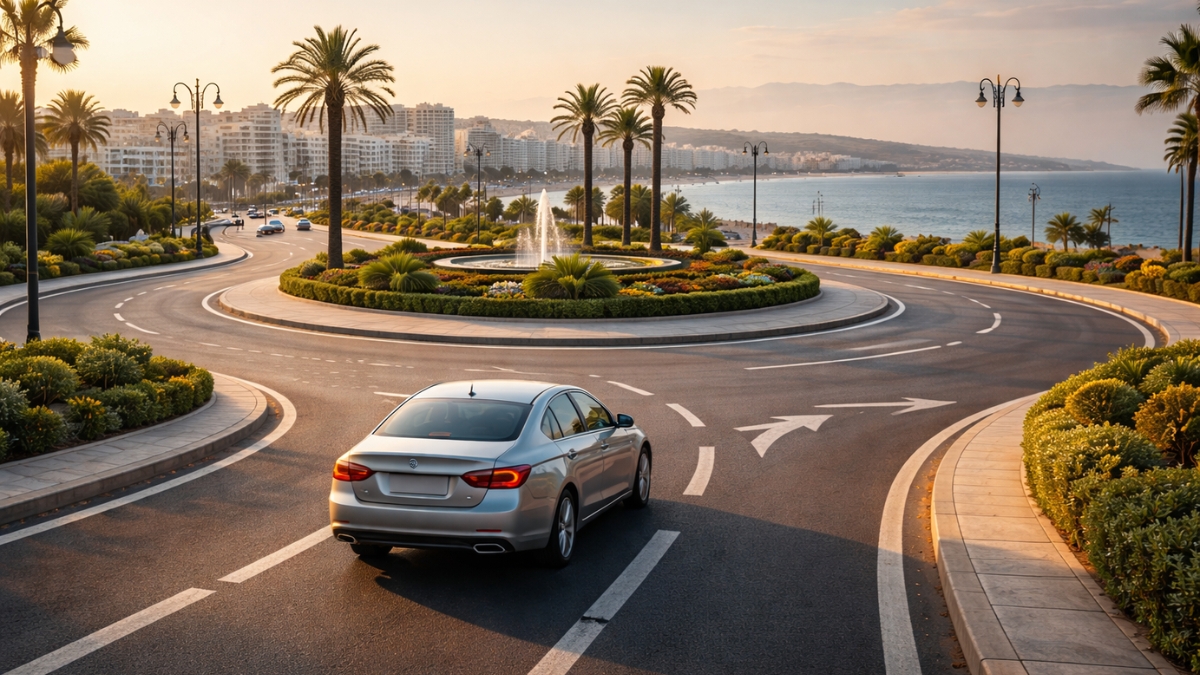
Roundabouts in Tangier can feel easy for two minutes… and then suddenly chaotic. The good news is that most “Tangier roundabout stress” comes from the same predictable moments: entering too late, choosing the wrong lane too early, or getting surprised by taxis and quick lane changes.
If you learn these five rules, you’ll drive roundabouts in Tangier with way less tension, whether you’re heading to the Corniche, the port side, or cutting across town.
Table of Contents
Rule #1: Read the signs and road markings first
Rule #2: Give way the smart way (not the panicked way)
Rule #3: Choose your lane early, then stay in it
Rule #4: Signal late enough to be useful
Rule #5: Expect “local rhythm” (taxis, scooters, and short merges)
Plus: Two fast examples + common mistakes + image prompt
Rule #1: Read the signs and road markings first
In Tangier, roundabouts range from small neighborhood circles to larger multi-lane junctions. What stays consistent is this: the road tells you what to do, if you look early enough.
Before the roundabout, scan for:
lane arrows painted on the road (straight / left / right / U-turn)
yield markings (often triangular “shark teeth” or a broken line at entry)
overhead direction boards (especially near bigger junctions)
Visitor habit that works: slow slightly earlier than you think you need to, so you can read the road without last-second swerves.
If roundabouts aren’t common where you live, this simple overview explains why roundabouts work and why they force lower speeds: Roundabouts.
Rule #2: Give way the smart way (not the panicked way)
Most roundabout problems happen at the entry, either someone enters too aggressively, or someone stops when they didn’t need to.
Use this “smart give-way” approach:
Yield when you must (to circulating traffic, or when signs/markings require it).
Don’t stop if it’s clearly open (unnecessary stopping creates rear-end risk and blocks flow behind you).
Enter smoothly when you see a safe gap, commit and keep moving.
Tangier reality: some drivers will “test” small gaps. Your job isn’t to compet, it’s to enter cleanly when safe, and avoid hesitation that confuses everyone around you.
Rule #3: Choose your lane early, then stay in it
If you only remember one thing, remember this: lane changes inside a roundabout are where near-misses happen.
A simple lane mindset that helps in Tangier
If you’re going right / first exit, position toward the outside lane early.
If you’re going straight, follow the lane arrows and signs, many roundabouts allow straight from more than one lane.
If you’re going left / U-turn, choose the lane that clearly supports it (often an inside/left lane).
Then: stay in your lane as you circulate. If you miss your exit because traffic is tight, don’t cut across, go around again. It’s normal, and it’s safer.
Why this matters more in Tangier
You’ll often share the circle with:
taxis moving quickly to reach curb-side stops
scooters slipping through gaps
drivers who signal late or not at all
Staying predictable keeps you safe.
Rule #4: Signal late enough to be useful
Signaling at roundabouts is tricky because signaling too early can mislead people.
A practical, low-stress method:
Signal right only if you’re taking the first exit.
If going straight, many drivers don’t signal on approach, then signal right just after you pass the exit before yours.
If turning left/U-turn, keep your position consistent, then signal to exit when you’re leaving.
The one signal rule that prevents confusion
Signal only when you’re actually about to exit.
That helps the driver waiting to enter understand what you’re doing.
If you want a deep-but-clear guide (with diagrams and common crash patterns) from a transportation authority, this PDF is excellent: Roundabouts: An Informational Guide.
Rule #5: Expect “local rhythm” (taxis, scooters, and short merges)
Tangier has its own driving rhythm, and roundabouts are where you feel it most.
Here’s what to expect, and how to handle it calmly:
Taxis may slow suddenly near exits
They’re often scanning for passengers or pulling toward the curb at the next road.
Your move: keep extra following distance and avoid tailgating inside the circle.
Scooters/mopeds may appear in blind spots
Especially in the outside lane or near exits.
Your move: mirror checks before exiting, and avoid squeezing toward the curb too early.
Short merges create “squeeze moments”
Some entries and exits are close together.
Your move: don’t rush the entry. A clean gap is worth waiting one extra second.
Golden rule in Tangier: predictability beats speed. Smooth beats aggressive.
Two fast examples (how to think in real time)
Example 1: “I’m going straight”
Choose the lane that clearly supports straight ahead (follow arrows/signs).
Yield if needed, enter smoothly.
Stay in lane.
After passing the exit before yours, signal to exit.
Exit without cutting across.
Example 2: “I missed my exit”
Don’t brake hard or swerve.
Keep circulating, reset your lane position, and take the next safe opportunity to exit. It costs you 30 seconds and saves you a lot of risk.
Common visitor mistakes (avoid these)
Stopping when the entry is clearly open (confuses drivers behind you)
Changing lanes inside the roundabout (highest near-miss risk)
Signaling too early (others think you’re exiting sooner)
Entering too fast (you lose time to read signs and choose lane)
Trying to “force” an exit (go around again instead)
