
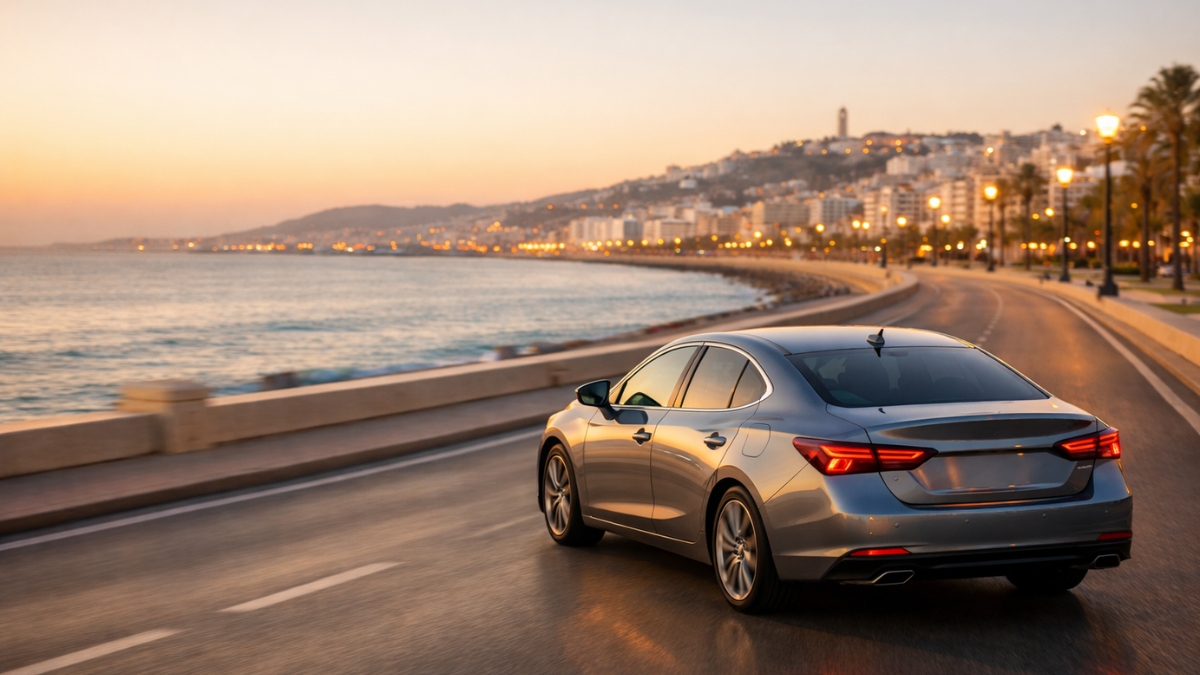
Tangier’s Corniche is one of the easiest “scenic drives” in Morocco, until it suddenly isn’t. One moment you’re gliding along the waterfront, the next you’re stuck behind a slow merge, a double-parked taxi, or a roundabout that feels like it never clears.
This Tangier Corniche driving guide breaks down what actually happens on the seafront road: where it bottlenecks, when it flows, and how to drive it with less stress, especially on weekends and evenings.
Table of Contents
-
What people mean by “Tangier Corniche”
-
Where it bottlenecks (the usual slow zones)
-
Where it flows (the easiest stretches)
-
Best times to drive the Corniche
-
Parking reality by zone (beach, marina, cafés)
-
Two easy tactics to avoid stop-and-go
-
Quick FAQ
1) What people mean by “Tangier Corniche”
When travelers say “Tangier Corniche,” they usually mean the waterfront road running along Tangier Bay, connecting popular areas like the beach promenade, café strips, and the marina/port side.
It’s not a single “highway-style” road. It’s an urban coastal corridor with:
-
frequent junctions and roundabouts
-
pedestrian crossings
-
taxis stopping for pickups
-
evening crowd patterns that change by the hour
So the Corniche isn’t hard to drive, it’s easy to enter but tricky to time.
2) Where it bottlenecks (the usual slow zones)
These are the places where traffic slows most often, even when the rest of the Corniche feels fine.
Bottleneck A: Marina / port-side approaches
This zone tends to slow when:
-
people are entering/exiting marina areas
-
there’s event traffic (restaurants, hotels, waterfront spots)
-
multiple lanes funnel into fewer usable lanes
Driver tip: choose your lane early and stay calm. This area punishes last-second lane changes.
Bottleneck B: Roundabouts and “short merges”
Tangier’s seafront roundabouts can stack up because:
-
flow depends on gaps, not lights
-
drivers enter aggressively during busy moments
-
one hesitant driver can slow the entire rotation
Driver tip: keep a predictable pace and leave space. You don’t want sudden braking here.
Bottleneck C: Beachfront “stop zones” (taxis + quick pickups)
Near busy café stretches and promenade entry points, you’ll see:
-
taxis stopping briefly
-
cars pausing for drop-offs
-
pedestrians crossing unpredictably
Driver tip: treat the right lane as “unstable” in peak hours. The smoother lane is often the one with fewer stopping vehicles.
Bottleneck D: Weekend sunset-to-nightfall surge
The Corniche has a very specific pattern: it can be okay during the day, then get crowded fast around sunset and early evening when people come out for the promenade.
Driver tip: if you’re trying to arrive somewhere (not just cruise), avoid the 30–60 minutes around sunset on weekends.
3) Where it flows (the easiest stretches)
The Corniche flows best when there’s less stopping behavior and fewer “decision points.”
Flow Zone A: Early morning seafront
Early morning is the calmest time:
-
fewer café pickups
-
fewer pedestrians stepping into crossings
-
smoother roundabout gaps
If you want the “scenic drive” version of Tangier, this is it.
Flow Zone B: Midday outside peak lunch hours
Midday often drives smoothly, especially if you avoid:
-
lunch arrival bursts (people entering restaurants)
-
school pickup windows in nearby areas
Flow Zone C: Late evening (after the crowd thins)
After dinner hours, the Corniche often relaxes again and becomes easier to park near.
4) Best times to drive the Corniche
Use these simple rules:
Best times (smoothest)
-
Early morning (least traffic + easiest parking)
-
Midday (especially on weekdays)
-
Later evening (after the main promenade rush)
Most likely to be slow
-
Weekend late afternoon → evening
-
Holiday nights
-
Any time there’s a big waterfront event
If you’re unsure, check live conditions right before you leave using Google Maps traffic or Waze Live Map. (These are also the fastest way to spot “one single junction” causing a long chain reaction.)
5) Parking reality by zone (beach, marina, cafés)
Parking is often the real source of Corniche stress—not the driving.
Beach promenade parking
-
Easiest strategy: park slightly inland and walk 5–10 minutes
-
Why: beachfront spaces fill first, and circling adds more time than walking
Marina-side parking
-
Often more organized, but can get congested at entry/exit times
-
Tip: if you arrive during a busy wave, park once and stay on foot for a while rather than moving the car again
Café/restaurant strip parking
-
This is where double-parking and “quick stops” happen most
-
Tip: if you’re meeting someone, choose a clear pickup point (not “somewhere near the café”) to avoid blocking traffic
Simple rule: if your plan involves the Corniche on a weekend evening, decide your parking plan before you drive there.
6) Two easy tactics to avoid stop-and-go
These two habits reduce stress immediately:
Tactic 1: Drive the Corniche for the view—enter inland for the destination
If you’re going to a specific restaurant/hotel, the smooth approach is often:
-
use the Corniche for the scenic stretch
-
then enter via a calmer inland street for the final approach (less stopping traffic)
Tactic 2: Avoid “peak entry points” by shifting your timing 30–45 minutes
On weekends, simply leaving:
-
a little earlier than sunset, or
-
later after the first crowd wave
can turn a slow crawl into a smooth drive.
7) Quick FAQ
Why does Tangier Corniche traffic suddenly slow down?
Usually due to short merges, roundabout backups, and stopping taxis/drop-offs near café and promenade zones.
When does Tangier Corniche flow best?
Early morning and midday (especially weekdays). Late evening can also be smooth after the crowd thins.
What’s the biggest mistake drivers make on the Corniche?
Hunting for “front-row” parking near the promenade during peak hours. It’s faster to park slightly inland and walk.
Is it better to use Google Maps or Waze for the Corniche?
Both work well. Use whichever you already trust, both show live congestion and reroutes.
